How We Learned to Sail · Chapter 1
A Boat Before Sail
Before a boat can go anywhere, it has to perform the rather more urgent trick of not sinking.
That sounds too obvious to deserve a chapter. It is not. The finished sailing yacht bundles so many jobs into one elegant object that the jobs become hard to see. Its hull carries the crew. Its sails drive it. Its rudder turns it. Remove the sails and the mast and the ropes, however, and the first problem remains in its pure form: how can people and their belongings occupy a piece of water without having to swim?
A fallen trunk offers one answer. It displaces water and can support weight, although it is inclined to roll and has nowhere convenient to put lunch. Reeds, bark, skins and timbers offer others. Tie buoyant things together, hollow out a log, stretch a covering over a frame or join pieces into a watertight shell, and the result can carry more than a swimmer can. The construction may be simple or extraordinarily accomplished. The functional idea is the same.
Once that floating structure is doing useful work, it earns a name: the hull. A hull solves the problem of being carried. It does not, merely by floating, solve the problem of going somewhere.
The missing beginning
There is no sensible date for the invention of the boat. This is not coyness. It is a consequence of what boats were made from and where they were left.
Wood, bark, reeds, fibre and hide are all useful boatbuilding materials and generally poor correspondents with the distant future. Exposed to oxygen, microbes and weather, they decay. They survive unusually well when buried in conditions that slow that decay, particularly waterlogged or oxygen-poor sediment. Archaeologists therefore find a selective sample: the craft that happened to enter favourable ground, remained there, escaped later destruction and were eventually noticed.
Indirect evidence reaches much further back than any surviving hull. Reaching the ancient continent of Sahul, which joined Australia and New Guinea when sea levels were lower, still required several sea crossings through the islands of Wallacea. Modelling of the ancient coastlines and currents indicates that people could plan such voyages by at least 50,000 years ago. One crossing approached 100 kilometres. We do not know what those travellers called their craft, how they were built or how many earlier kinds left no trace. The crossing is evidence of a capability, not a recovered design.
The surviving record begins much later. One remarkable survivor is the Pesse logboat, found in peat near Pesse in the Netherlands. Hollowed from a pine trunk and roughly three metres long, the Drents Museum dates it broadly to around 8000 BCE. It is often introduced as the world’s oldest boat, a phrase that becomes safer with one extra word: it is the oldest known surviving boat. Even its interpretation has been questioned. A full-sized reconstruction floated and could be paddled, which shows that the object can work as a small boat. It cannot show who used the original, what they carried or precisely where they went.
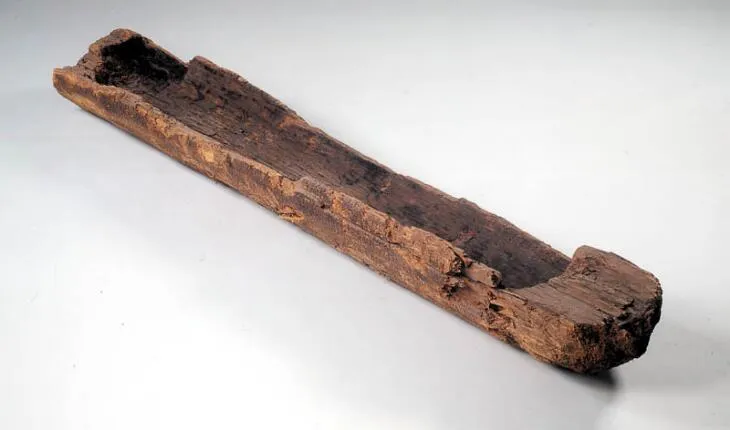
Figure 1. The original Pesse logboat, found near Pesse in the Netherlands and dated broadly to around 8000 BCE. Its surviving form is direct archaeological evidence; it does not reveal who used it, how it was handled or what much earlier craft looked like.
Credit. Boomstamkano van Pesse, Collectie Drents Museum, object 1955-VIII-2, via Wikimedia Commons, CC BY 3.0.

Nor can one lucky survivor stand for everything that preceded it. A hollowed log leaves one large piece of timber to be preserved. A raft of lashed branches can come apart. A hide-covered frame can lose its covering and become an assortment of sticks. Finding a logboat first does not mean that logboats were humanity’s first or only answer. It means that this one reached us in a form we can recognise.
This is the useful shape of the evidence. Humans were making deliberate water crossings tens of thousands of years before the oldest hulls now in museums. The archaeological record does not begin when boating began. It begins where perishable material happened to survive.
Three jobs, one boat
Imagine the Pesse logboat resting on quiet water with a person aboard. It is already succeeding. The hull supports its load whether the occupant works or not. Leave it alone, though, and its route will be decided by current, wind and chance. A boat that merely floats is transport only in the rather loose sense that it may eventually arrive somewhere.
To choose an arrival, two more jobs appear.
The first is to make the boat move relative to the surrounding water. A pole can push against the bottom in the shallows. A person or animal on land can tow from the bank. A blade can be put into the water and swept backwards so that the boat is driven forwards. These are different methods of propulsion, the job of producing useful motion.
The second is to control the direction of that motion. Push harder on one side, drag a blade on the other, trail a blade at the stern or change where the propulsive force acts, and the boat turns. This is steering. It may be done with the same tool and the same pair of arms that provide propulsion, but it remains a different job. A tired paddler can stop driving the boat while still making a small corrective stroke. A steerer at the stern can change direction without contributing much forward thrust.
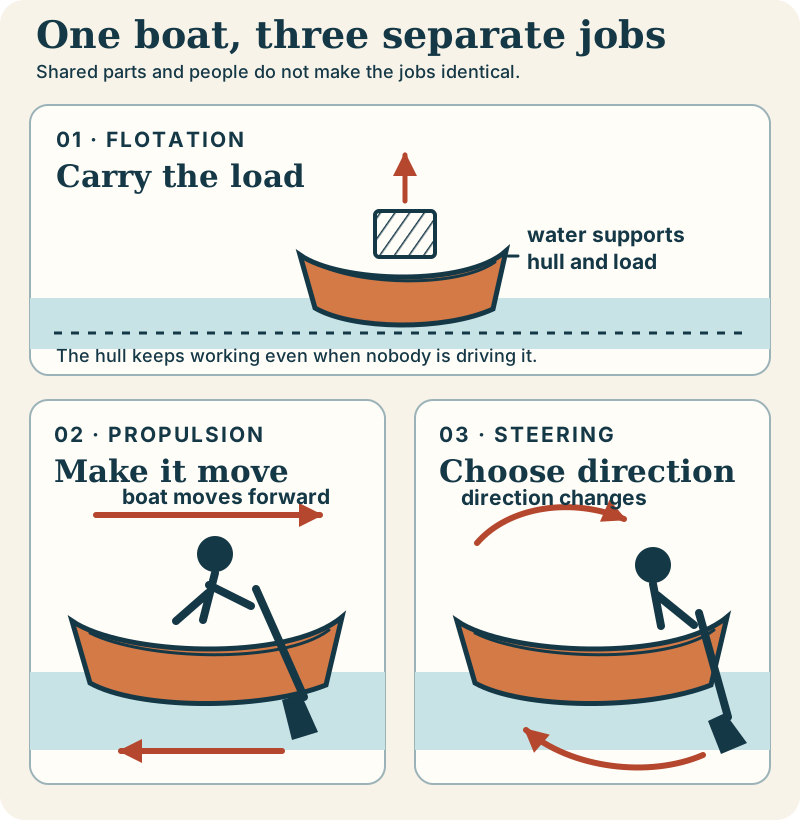
Figure 2. Flotation carries the load, propulsion produces motion and steering changes its direction. One person or tool can perform more than one job, but that does not make the jobs identical. The boat is intentionally diagrammatic and does not represent a particular culture or period.
The distinction matters because each job can be improved without automatically improving the others. A broader or more capacious hull may carry a larger load yet remain no easier to move. More paddlers may make it faster while doing nothing for its ability to float. A powerful stroke on the wrong side may supply excellent propulsion in an increasingly unhelpful direction.
A blade in the water
A paddle is held by its user rather than mounted on the boat. The blade pushes water backwards and the reaction drives paddler and boat forwards. The paddler can move the stroke from side to side, alter its direction or hold the blade against the water to help turn. It is a compact answer to propulsion and steering, especially where the crew can reach the water easily.
There is another way to arrange the leverage. Let the shaft work against a peg, notch or other bearing on the hull and the boat itself becomes the support about which the blade turns. This is an oar. The distinction is mechanical rather than a judgement about sophistication: a paddle is freely held; an oar normally works against a pivot on the boat. The bearing allows a longer lever and gives the crew a firm structure against which to pull. Oars can be multiplied along a larger hull. More people can apply more force, and they can apply it in a disciplined rhythm rather than as a collection of private opinions.
That arrangement solves more than a problem of vocabulary. The rower no longer has to support every sideways load with arms and torso alone; some of it enters the hull at the bearing. In return, the hull must provide a strong and suitably placed support, and the crew must have room to move the handles. Better leverage has acquired a structural and spatial bill.
Neither arrangement belongs to one neat rung on a ladder of progress. Paddles, oars, poles and towlines coexist because waterways, hulls, loads and available labour differ. A pole is remarkably direct until the bottom becomes too deep. Towing can move a heavy boat efficiently where a bank and towpath cooperate. A paddle needs little fixed equipment. An oar asks more of the hull but can offer useful leverage.
A crew divided
By the early second millennium BCE, an Egyptian craftsperson made a wooden model that shows the jobs separated with unusual clarity. It came from the tomb of Meketre at Thebes and represents a ritual journey towards Abydos. Sixteen kneeling paddlers are arranged along the hull. At the raised stern, two much larger blades are positioned for steering.
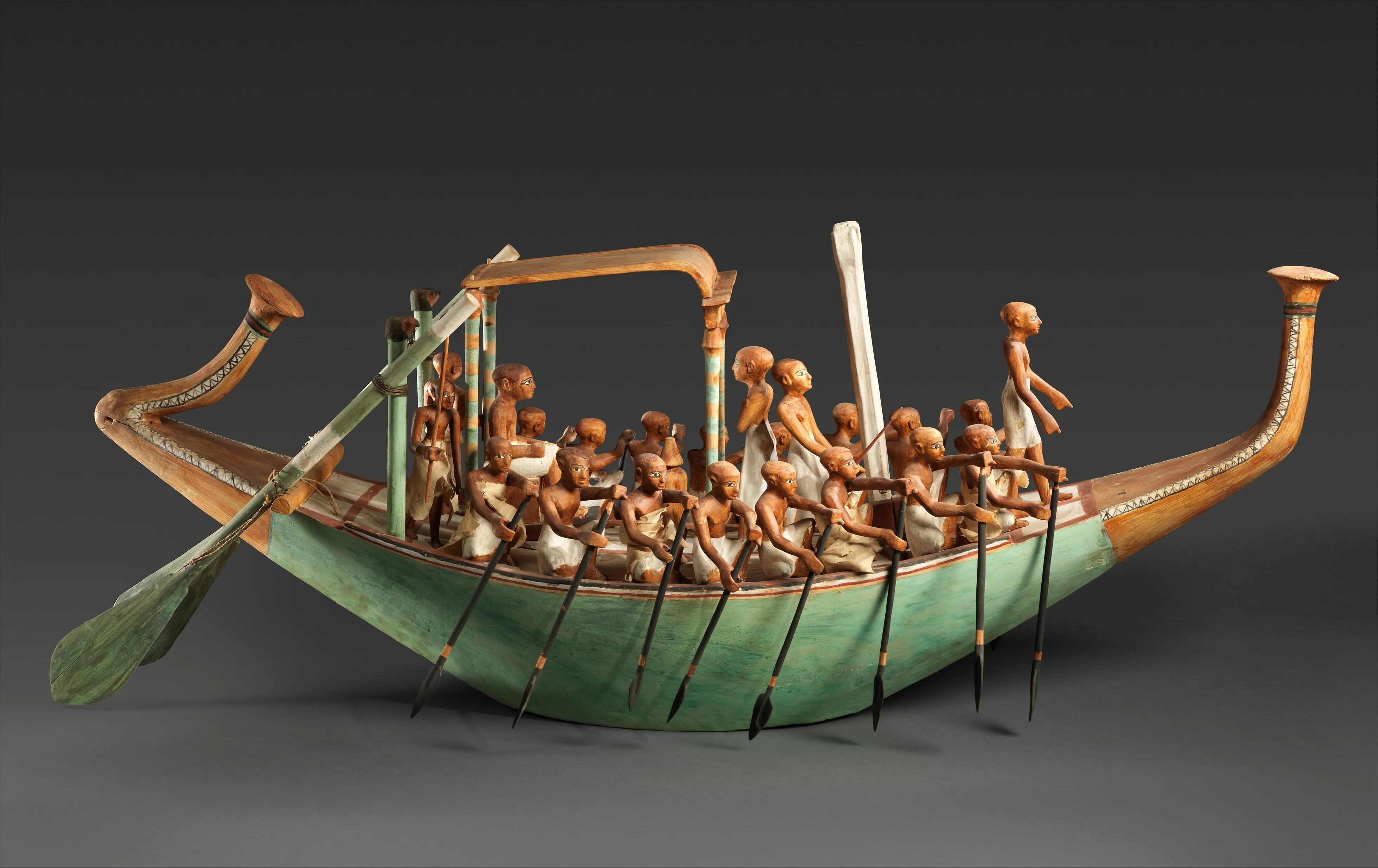
Figure 3. Model Paddling Boat, about 1981–1975 BCE, from the tomb of Meketre, Thebes. The ancient funerary model is evidence for an Egyptian representation of a papyrus-form boat, paddlers and paired steering oars. It is not a scale drawing of a surviving full-sized vessel.
Credit. The Metropolitan Museum of Art, object 20.3.5. Public Domain.
The model is more than a pleasingly busy object. The paddlers face one shared task: keep applying strokes to drive the hull. The steering oars have a different geometry and position because direction has become a specialised concern. A small crew might blend the roles from one moment to the next. Here the model gives them separate places.
It also guards against a tempting historical mistake. The Pesse logboat and Meketre model are separated by roughly six thousand years and come from very different societies and environments. The later object is not the next frame in a universal sequence. It shows that, in one well-documented Egyptian context, people represented a large crew, human propulsion and dedicated steering as parts of one boat. The conceptual relationship is real. A single lineage between the two objects is not in the evidence.
The price of every stroke
Human-powered boats can be formidable. They can accelerate briskly, manoeuvre delicately, cross open water and carry loads that would be miserable to move along a rough shore. Better leverage helps. More paddlers or rowers help. Training, coordination and a hull suited to the work help. None of this makes the labour primitive or the craft incapable.
It does leave one stubborn limit untouched.
Every useful stroke transfers energy from a person to the boat and then to the surrounding water. The moving hull continually loses energy to water and waves. To keep a steady speed, the crew must keep replacing it. A larger crew can supply more power, but it also adds people who must be carried, fed and given room to work. Better leverage can exchange force for movement at the handle. It cannot create energy. The accounting remains impolite but exact.
What if everybody stops?
The hull continues to float because flotation never depended on the paddlers’ effort. The boat continues moving for a while because it already has momentum. Propulsion has ended, however, so resistance slows it. Steering may still work while water is flowing past a steering blade, but its authority fades with the boat’s speed. Eventually the three jobs have separated themselves rather neatly: the hull is still afloat, the propulsive force is gone and there is scarcely enough motion left to steer.
Rest solves the crew’s immediate problem by creating the boat’s next one.
Energy without a crew
There is energy in the environment. A river current can carry a boat and its occupants for hours without asking them to make the water move. The bargain is control. The current goes where the river goes, at the pace and in the direction the channel permits. It is useful transport when its destination agrees with yours and a geographical opinion when it does not.
The air is moving too. Wind wrinkles the surface, bends reeds and presses against every exposed person and object aboard. Unlike a towpath, it can reach a boat far from the bank. Unlike a river current, it may cross the water in directions that are not fixed by the channel. It is variable, untidy and plainly capable of doing work.
The hull has solved flotation. Human hands have solved propulsion and steering. The remaining inconvenience is that those hands must keep working. If the moving air could be made to push something attached to the boat, perhaps the crew could stop being the engine.
That possibility is where sailing begins.