How We Learned to Sail · Chapter 9
Why She Heels, and Why She Comes Back
A sailing yacht is pushed by two fluids at once. The air presses on the sails above the water. The water presses back on the hull and its underwater surfaces below it. Those forces can drive the yacht forwards, but their positions also give the whole boat a reason to roll.
By this point in the story, we have already met the broad arrangement. The sail develops an aerodynamic force with a large sideways component. The underwater body develops an opposing hydrodynamic force as it moves through the water with a little leeway. The two belong to one coupled system. For this chapter, we need only add a fact that is obvious once seen and easy to overlook before it is drawn: they do not act at the same height.
Two arrows that do not meet
Imagine pushing the top of a closed book to the right while pushing its bottom to the left. The pushes may be equal, so the book does not travel sideways across the table. It still turns.
A sailing yacht has the same sort of problem. The sideways force from the sails acts mainly above the water, while the opposing force from the hull and underwater surfaces acts below it. The two may balance sideways without cancelling their tendency to roll the yacht, because their lines of action are separated vertically. That turning effect is a heeling moment.
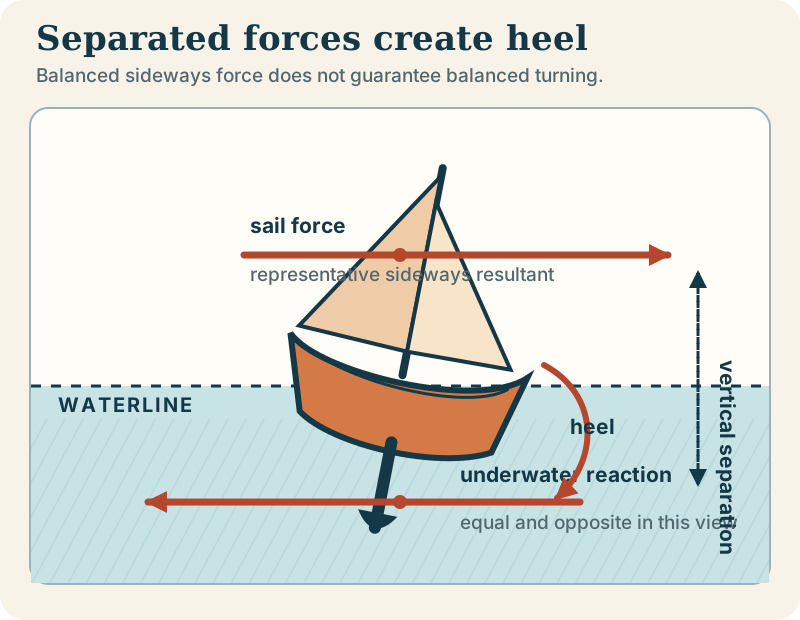
Figure 1. Opposing sideways forces can still roll the yacht because they act at different heights. The arrows are representative resultants and their separation is exaggerated for clarity.
The word moment describes the turning effect of a force acting at a distance. Increase the force and the turning effect grows. Keep the force but move its line of action farther from its partner, and the turning effect grows again. A longer spanner makes the same lesson with a less expensive object.
The arrows are a piece of useful bookkeeping, not a claim that the air and water each push at one tidy spot. Pressure and friction are spread over sails, hull, keel and rudder. Their resultants also change as the yacht accelerates, heels and meets waves. Combining each distributed effect into one arrow lets us see the roll tendency without pretending that the surrounding flow has become simple.
It also separates heel from sideways travel. If the transverse forces are briefly unequal, the yacht can accelerate sideways as well as roll. In a steady first approximation they balance in force while retaining a moment because of their height. Translation may be balanced; rotation is not yet balanced.
The yacht therefore begins to heel. If nothing changed as it rolled, there would be no reason for it to stop. Something does change, and most of it is below the waterline.
The immersed shape changes
An upright yacht floating quietly has two large vertical forces in balance. Its weight acts downwards through its centre of gravity. Buoyancy acts upwards through its centre of buoyancy. The forces are equal, and their lines pass through the same vertical, so they do not turn the hull.
Neither centre is a magic fitting hidden inside the boat. The centre of gravity is the combined centre of every mass aboard: hull, rig, machinery, stores, people and ballast. The centre of buoyancy is the centre of the volume of water displaced by the hull, a convenient point through which we can represent the distributed pressure of the water.
For a floating surface vessel, the centre of gravity does not have to sit below the centre of buoyancy. That rule belongs to a fully submerged body whose immersed shape does not change when it rotates. A yacht pierces the surface. Its waterplane and immersed volume change with heel, and that changing geometry can create a restoring effect even when G is above B.
Now heel the yacht. Weight does not suddenly abandon the yacht’s centre of gravity. Buoyancy, however, has a newly shaped job. One side of the hull rises out of the water while the other sinks farther in. The immersed volume is no longer the upright volume tilted like a rigid block. Its shape has changed, so its centre changes too. The centre of buoyancy moves towards the more deeply immersed side.
One way to picture the change is to compare two wedges of hull beside the waterline. A wedge that was immersed on the rising side leaves the water. A new wedge enters on the sinking side. The total displaced volume remains appropriate to the yacht’s weight in this calm-water comparison, but its distribution has moved sideways. The centre of that distribution moves with it.
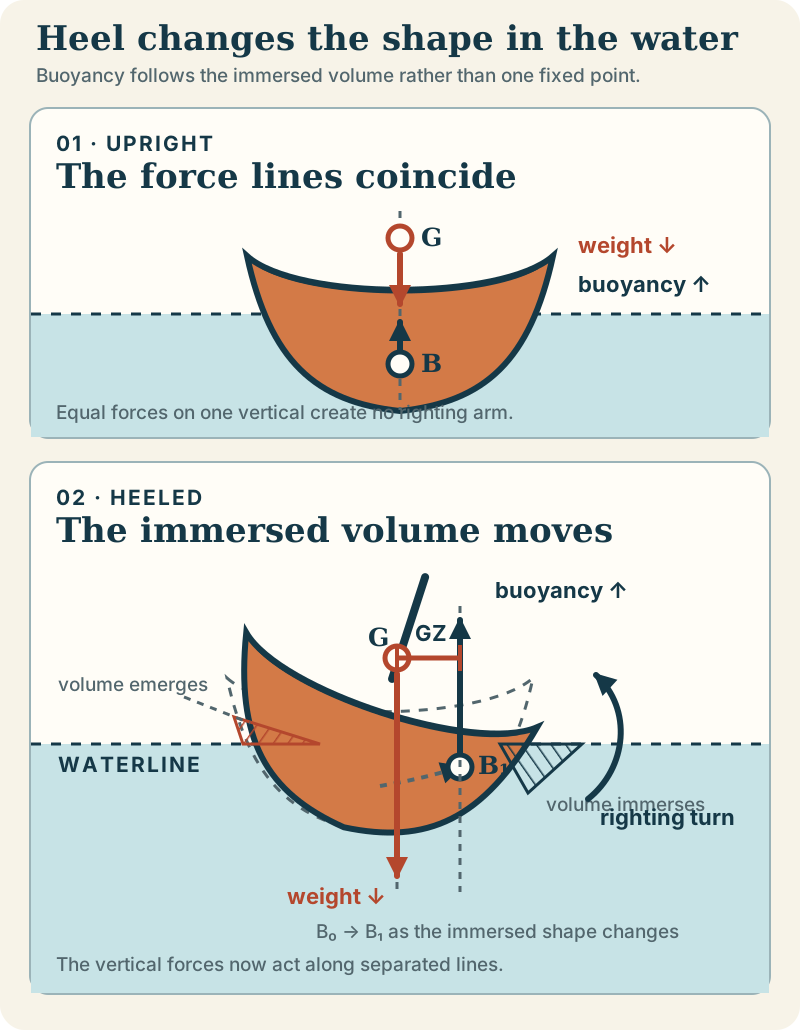
Figure 2. Heel changes the immersed shape and moves the centre of buoyancy from B₀ to B₁. The resulting horizontal gap between the vertical weight and buoyancy lines is the righting arm, GZ. The geometry is diagrammatic rather than a calculation from a real hull.
At this representative heel, the upward buoyancy line lies to one side of the downward weight line. The shortest distance between those vertical lines is the righting arm, conventionally called GZ. Equal upward and downward forces acting along separated lines form another couple, this time tending to roll the hull back towards upright. Multiply the yacht’s displacement weight by GZ and the result is its hydrostatic righting moment at that condition.
GZ is not a physical strut between G and B. It is a distance constructed between force lines at one angle and one loading condition. If the centre of buoyancy moves farther sideways, the arm can grow. If the centre of gravity is higher, the weight line may lie closer to the buoyancy line and the arm can shrink. Hull form and mass distribution have entered the same piece of geometry.
The sequence matters. The yacht does not return because buoyancy always pushes from one fixed point beneath it, and it does not return because the keel hangs like a pendulum from the hull. Heel changes the immersed geometry. The changing geometry moves the centre of buoyancy. Weight and buoyancy can then acquire the leverage that produces a righting moment.
While the yacht sails steadily, it need not become upright. It settles around an angle where the heeling effects and righting effects balance for the moment. Ease the sail force and the balance changes. If the hull still has a positive righting arm in that condition, the righting moment has the advantage and the yacht rolls back.
Stability can be in the shape
The movement of buoyancy explains why ballast is not the only route to stability. A broad hull can immerse a substantial new volume on its lower side after only a modest heel. Its centre of buoyancy may move sideways quickly, creating useful righting leverage even if the centre of gravity is not exceptionally low. This contribution from geometry is form stability.
A narrow hull and a wide hull can therefore behave differently with the same total weight. Yet “wider is more stable” is only a beginning, not a design rule. Section shape, freeboard, loading and heel angle determine how the immersed volume develops. A beamy hull may have strong initial stability while its righting arm behaves very differently at larger angles.
That distinction between early and later behaviour matters. Initial stability describes the response near upright. It can tell us why one hull resists the first few degrees of heel more strongly than another, but it cannot by itself say what happens after the deck edge immerses or the hull approaches inversion. A brisk resistance to small heel and an ability to recover from a very large heel are not the same property.
An outrigger carries the idea beyond the side of the main hull. As the craft heels towards it, the float immerses and supplies buoyancy with a long transverse lever. A catamaran separates two large buoyant volumes: the leeward hull carries more of the displacement while the windward hull carries less. These arrangements can have formidable initial stability without a deep lead keel.
They are not loopholes in the physics. They use the same relationship among weight, immersed volume and leverage, arranged differently. Their structures, motion, drag and behaviour at very large heel or inversion are different in return. Putting buoyancy farther outboard is another perfectly good answer, not a way to obtain every kind of stability at once.
Put weight where it can help
Hull shape moves the buoyancy side of the righting arm. A designer can also move the weight side.
Ballast is dense mass carried to place the yacht’s centre of gravity usefully low. It may sit inside the hull, run along an external keel or gather in a bulb beneath a fin. Wherever it sits, the centre of gravity marked G still belongs to the complete yacht. It is not the centre of the ballast alone.
Suppose the ballast mass stays exactly the same and every other part of the yacht stays where it is. Move that ballast lower and the combined centre of gravity moves lower too, but by a smaller distance because the ballast is only part of the total mass. At a fixed representative heel, with the same hull and displacement, that lower G can put the weight line farther from the buoyancy line. GZ becomes longer. The yacht weighs no more than before, but its weight has gained more righting leverage.
The smaller movement of G is important. If ballast were one third of the yacht’s total mass, moving it a given distance would move the combined centre of gravity only one third as far while everything else stayed fixed. The figures use that kind of weighted-average relationship. They do not drag G down to the bulb or allow the ballast to swing independently beneath the hull.
Before the figure, make a prediction. If the ballast mass is unchanged, why can lowering it increase its contribution against heel, and what practical cost appears immediately?
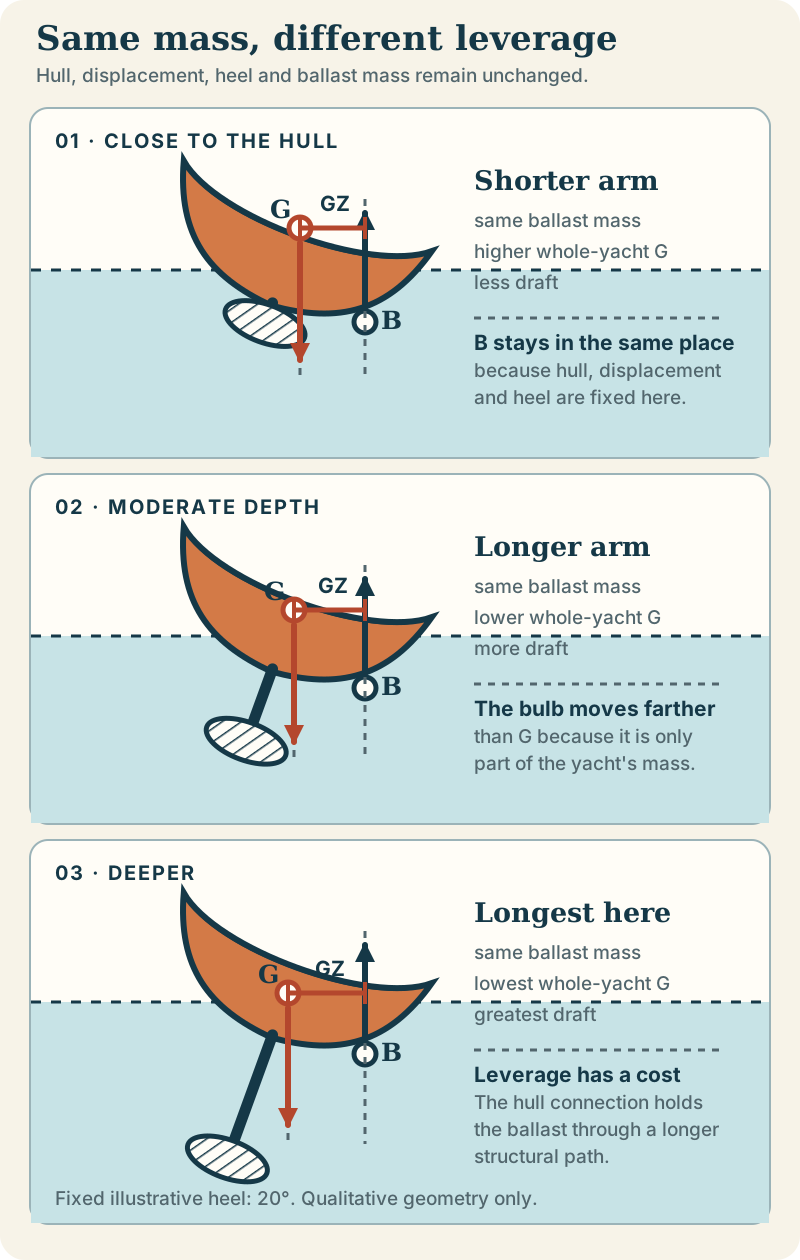
Figure 3. Same hull, displacement, ballast mass and illustrative 20-degree heel. Only ballast depth changes: the whole-yacht centre of gravity moves by a smaller amount and GZ lengthens in this controlled comparison. This is a qualitative teaching model, not a yacht-stability calculation.
The answer is leverage, not extra weight. The deeper ballast shifts the whole-system centre of gravity and changes the separation of the force lines at this heel. The immediate cost is draft: the yacht now reaches farther below the surface. The longer keel also has to carry its ballast and sailing loads farther from the hull connection.
This contribution is often called ballast stability. It is powerful, especially when dense material can be concentrated low down, but it never works alone. The hull still displaces the water. Its centre of buoyancy still moves with heel. The rig, accommodation, tanks, equipment and people still help determine the overall centre of gravity. The sea remains under no obligation to hold the yacht at the one angle used in our drawing.
The bill arrives with the keel
A deeper ballast position can support more sail or provide the same illustrative righting leverage with less mass, depending on the complete design. It also creates a deeper object to ground, a greater restriction on shallow water and harbours, and a longer structural path between the ballast and hull. Real keel loads include hydrodynamic force, inertia, waves and the exceptionally abrupt arguments supplied by the seabed.
More initial righting effect is not automatically more comfort either. A yacht that resists small heel strongly may have a quicker, sharper rolling response. Nor does a low centre of gravity erase the consequences of hull form, freeboard or openings. Stability is the behaviour of a whole configuration through a range of conditions, not a prize awarded to the deepest bulb.
Our three-state comparison deliberately freezes almost everything. That makes one relationship legible, which is its purpose. A naval architect assessing a real yacht cannot freeze those things. The calculation must follow the actual hull and loading across heel angles, and must account for limits that this chapter has intentionally left outside the frame.
What “comes back” can promise
The title contains an important qualification. A yacht often comes back from an ordinary sailing heel because its righting moment grows enough to oppose the heeling moment, and because reducing the heeling force lets that righting effect dominate. It does not follow that every yacht will right itself from every angle.
As heel continues, the immersed geometry continues changing. GZ may grow, reach a maximum, shrink, become zero and eventually take the opposite sign. Hull form, loading, freeboard, watertight integrity and many other details affect that behaviour. Waves add motion and energy that a calm-water sketch cannot describe. Complete stability curves and safety criteria exist because one attractive lever arm at one angle is not enough.
For the mental model here, the useful result is simpler. Sail and underwater forces create heel because their lines of action are separated vertically. Weight and buoyancy can oppose that heel because their vertical lines become separated horizontally. Hull shape controls how buoyancy moves. Mass distribution controls where weight acts. Ballast is one way to improve the second of those, and deeper ballast buys leverage by accepting other costs.
One last separation remains. The forces we have followed sit not only above, below and beside one another, but also fore and aft. Their positions can give the yacht a preference about which way to turn. That is the problem waiting in Chapter 10.
Try the model
What does lowering ballast change?
The ballast mass will stay the same. Choose the explanation you expect, then test it against a deliberately controlled model.
Model state
- Only variable
- Ballast depth
- Held constant
- Hull, heel, displacement and ballast mass
- What follows
- Whole-yacht G moves a smaller distance; illustrated GZ grows.
- Immediate cost
- More draft and a longer structural path
Qualitative geometry only. This does not calculate a real yacht’s stability or predict recovery from every heel angle.